
ACIF
Case Studies
Automated Chemical Intelligence
Framework (ACIF)
About the Client
An organization handling chemical inventory and safety documentation required an intelligent system to process, validate, and manage highly sensitive chemical data. The client deals with diverse document formats including safety data sheets (SDS), inventory logs, and regulatory compliance documents. The objective was to transform unstructured and semi-structured chemical data into a reliable, compliant, and audit-ready system.
Challenges
- The client faced multiple operational and safety challenges due to manual and inconsistent document handling processes.
- Chemical documents varied significantly in format, including structured tables, unstructured text, and embedded hazard diagrams. This variability made automated extraction difficult and increased the risk of misinterpretation.
- Traditional OCR systems were insufficient as they lacked contextual understanding. They could extract text but failed to validate chemical names, identifiers, and hazard symbols, leading to silent errors that posed serious safety and compliance risks.
- Additionally, there was no unified mechanism to cross-verify extracted chemical information against trusted external databases. The absence of validation and compliance checks increased the likelihood of regulatory violations and unsafe handling of chemicals.
Solutions
- To address these challenges, an Automated Chemical Intelligence Framework (ACIF) was designed using a hierarchical multi-agent architecture powered by AI swarm intelligence.
- The system acts as an Intelligent Intake Department, capable of processing complex chemical documents with high accuracy and reliability.
- Incoming documents are first classified and routed dynamically based on their structure and content. Specialized extraction agents then process the documents to extract structured chemical data, including names, IDs, and composition details.
- A dedicated visual analysis component detects and interprets GHS hazard symbols from images and diagrams, enabling the system to understand both textual and visual safety information.
- The extracted data is then cross-validated using external chemical databases to ensure correctness. Ontology-based normalization standardizes chemical names and synonyms for consistency.
- Finally, a compliance validation layer enforces regulatory rules and flags low-confidence or high-risk entries for human review, ensuring audit readiness.
Architecture
The ACIF pipeline consists of multiple intelligent agents working collaboratively:
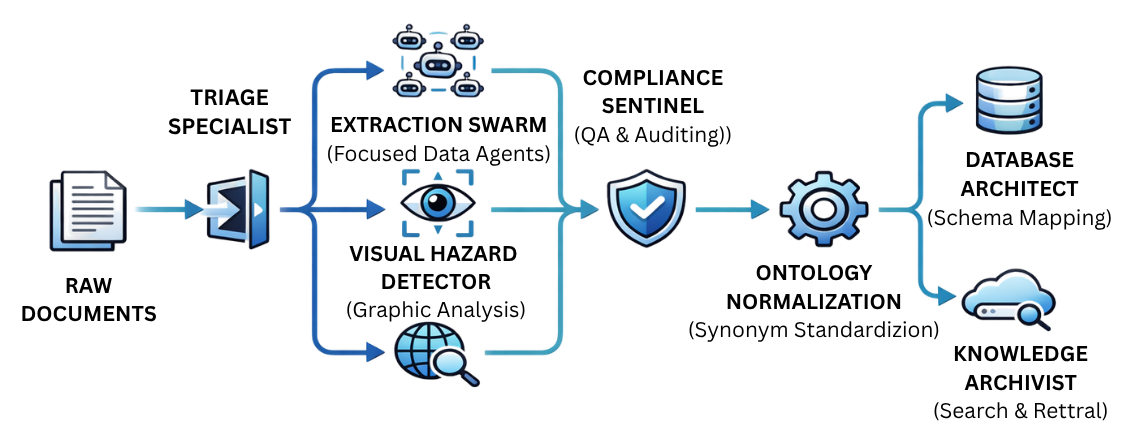
- Triage Specialist: Classifies and routes incoming documents.
- Extraction Swarm: Extracts structured chemical data.
- Visual Hazard Detector: Interprets hazard symbols and diagrams.
- Database Architect: Maps extracted data into structured schemas.
- Ontology Normalization: Standardizes chemical naming conventions.
- Compliance Sentinel: Applies validation rules and quality checks.
- Knowledge Archivist: Stores and enables retrieval of processed data.
Impact of the Solution
- The implemented framework significantly improved data accuracy and operational safety.
- A dual-layer validation mechanism eliminated silent data errors by combining extraction intelligence with external verification. The hybrid AI approach enabled reliable interpretation of both textual and visual chemical information.
- Confidence-based workflows ensured that uncertain data was flagged for human review, enabling audit-ready compliance processes. Overall, the system reduced manual effort, improved processing speed, and minimized safety risks associated with chemical data handling.
Technologies Used
- Artificial Intelligence & Multi-Agent Systems
- Computer Vision (for hazard detection)
- Natural Language Processing (NLP)
- Knowledge Graphs & Ontology Mapping
- External Chemical Databases (API-based validation)
- Workflow Orchestration Systems