
Data Platform with Databricks
Case Studies
Building a Scalable Retail
Data Platform with Databricks
About the Client
A retail organization operating across multiple sales channels required a structured and scalable data platform to manage and analyze large volumes of operational data. The client provided domain-specific datasets, including customer, orders, products, payments, and logistics data.
The primary objective was to transform this raw and distributed data into a reliable, scalable, and analytics-ready platform that supports accurate reporting and enables data-driven business decision-making.
Challenges
- Inconsistent schemas, duplicate records, and unstructured data resulted in poor data quality and unreliable reporting.
- Direct ingestion of data from GitHub was not supported due to file system limitations, requiring a custom ingestion approach.
- Managing raw file access and handling repository structure added complexity to the ingestion layer.
- Ensuring consistent data availability and maintaining data integrity during ingestion and processing required additional control mechanisms.
- Lack of orchestration in existing workflows required the implementation of a structured and automated pipeline.
Solutions
- To address these challenges, a scalable and production-ready data pipeline was implemented using Databricks, enabling efficient data ingestion, processing, and analytics across multiple business domains.
- The solution integrates GitHub as the source system and leverages Unity Catalog for secure and organized data storage.
- Data is ingested from the client-provided GitHub repository into Databricks using a controlled ingestion process.
- The ingested data is stored in Unity Catalog Volumes to ensure proper organization and accessibility.
- The data is then processed through multiple transformation layers to ensure quality, consistency, and usability.
- The solution enabled a unified and reliable data foundation, supporting accurate reporting and improved business decision-making.
Architecture
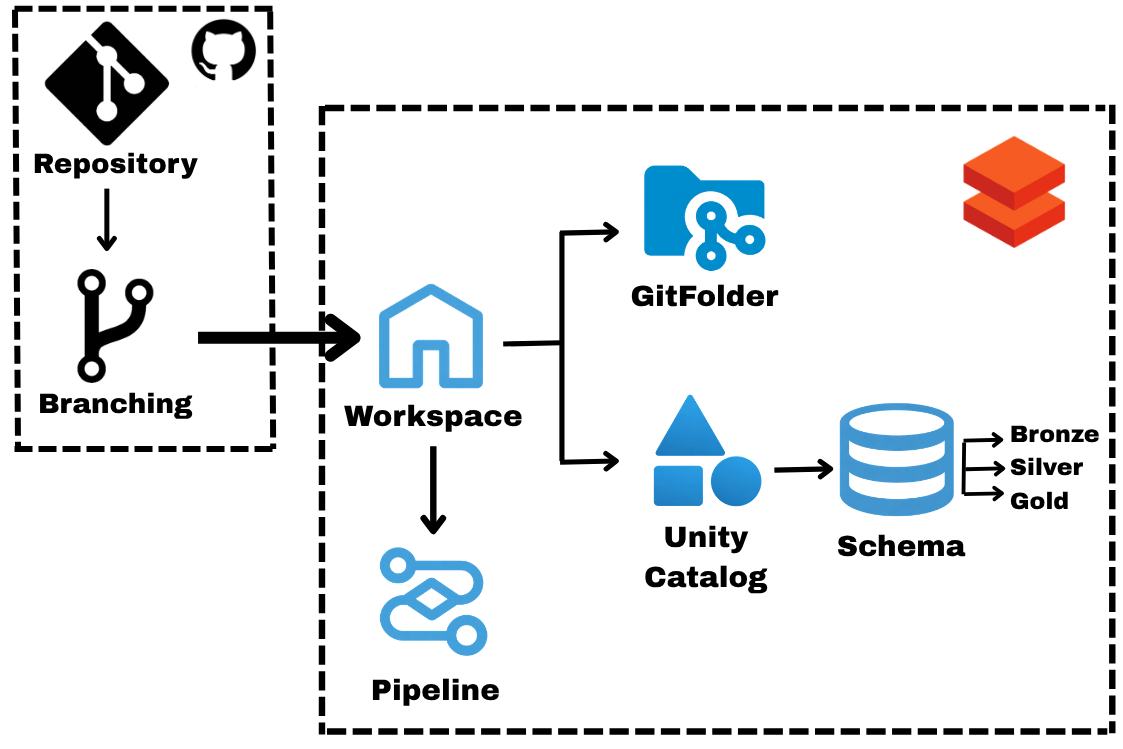
Bronze Layer
Stores raw data in Delta format, ensuring full traceability and reliable data ingestion from source systems.Silver Layer
Processes and refines data through cleaning, deduplication, and integration to create a consistent and high-quality dataset.Gold Layer
Delivers business-ready data models optimized for reporting, analytics, and decision-making.SCD Type 2
Implements Slowly Changing Dimensions to track historical changes in customer, product, and store data over time using Delta Lake.Impact of the Solution
- The implemented solution significantly improved data quality by eliminating inconsistencies and standardizing schemas across datasets.
- The structured Medallion Architecture enabled scalable data processing and simplified pipeline maintenance.
- The introduction of SCD Type 2 allowed the client to track historical changes effectively, enhancing analytical capabilities.
- The integration of GitHub with Databricks provided a streamlined workflow for managing both data and code, improving version control and reproducibility.
- Overall, the pipeline enabled faster data and more efficient processing, reliable reporting, and a strong foundation for future enhancements such as real-time processing and advanced analytics.
- The solution established a scalable and robust data platform, enabling the client to leverage data as a strategic asset.
Technologies Used
- Databricks
- Delta Lake
- Apache Spark (PySpark)
- Unity Catalog
- Databricks Jobs
- GitHub
- Databricks Repos