AERF

Case Studies
Adaptive Emotional Resilience
Framework (Emotional) (AERF)
About the Client
A digital wellness organization required an AI-powered emotional support platform capable of providing safe, personalized, and real-time mental wellness assistance to users across mobile and web applications.
The client needed an intelligent emotional resilience system that could:
- understand user emotions,
- provide empathetic conversations,
- monitor emotional well-being over time,
- detect crisis situations,
- and deliver personalized coping support using conversational AI.
The objective was to design a production-ready emotional wellness platform capable of delivering continuous emotional support while prioritizing user safety, personalization, and long-term engagement.
Challenges
The client faced several technical and operational challenges while building an AI-driven emotional wellness platform.
- Traditional chatbots lacked emotional memory and treated every conversation independently, resulting in poor personalization and low emotional engagement.
- Existing AI assistants generated generic responses that failed to support users experiencing emotional distress, anxiety, burnout, or loneliness.
- The system needed to safely identify crisis situations such as self-harm indicators, emotional breakdowns, and suicidal ideation without generating unsafe responses.
- The platform required long-term emotional trend tracking to understand mood patterns, emotional triggers, behavioral shifts, and user well-being progression over time.
- Building empathetic conversational behavior using Large Language Models (LLMs) required careful prompt orchestration, safety alignment, and emotional response tuning.
- The client also required adaptive lifestyle recommendations based on the user's emotional state, energy level, stress condition, and behavioral patterns.
- The platform needed scalable session memory and context retention to maintain continuity across conversations while protecting user privacy and ensuring secure emotional data handling.
Solution
To address these challenges, an Adaptive Emotional Resilience Framework named “Emotional” was designed using a multi-agent AI architecture focused on empathetic interaction, emotional intelligence, personalization, and safety-first conversational support.
The system acts as an intelligent emotional wellness companion capable of continuously understanding, monitoring, and supporting users through conversational AI pipelines.
User interactions are processed through a modular orchestration framework where multiple specialized AI agents collaboratively analyze emotional context, conversation history, behavioral patterns, and safety indicators.
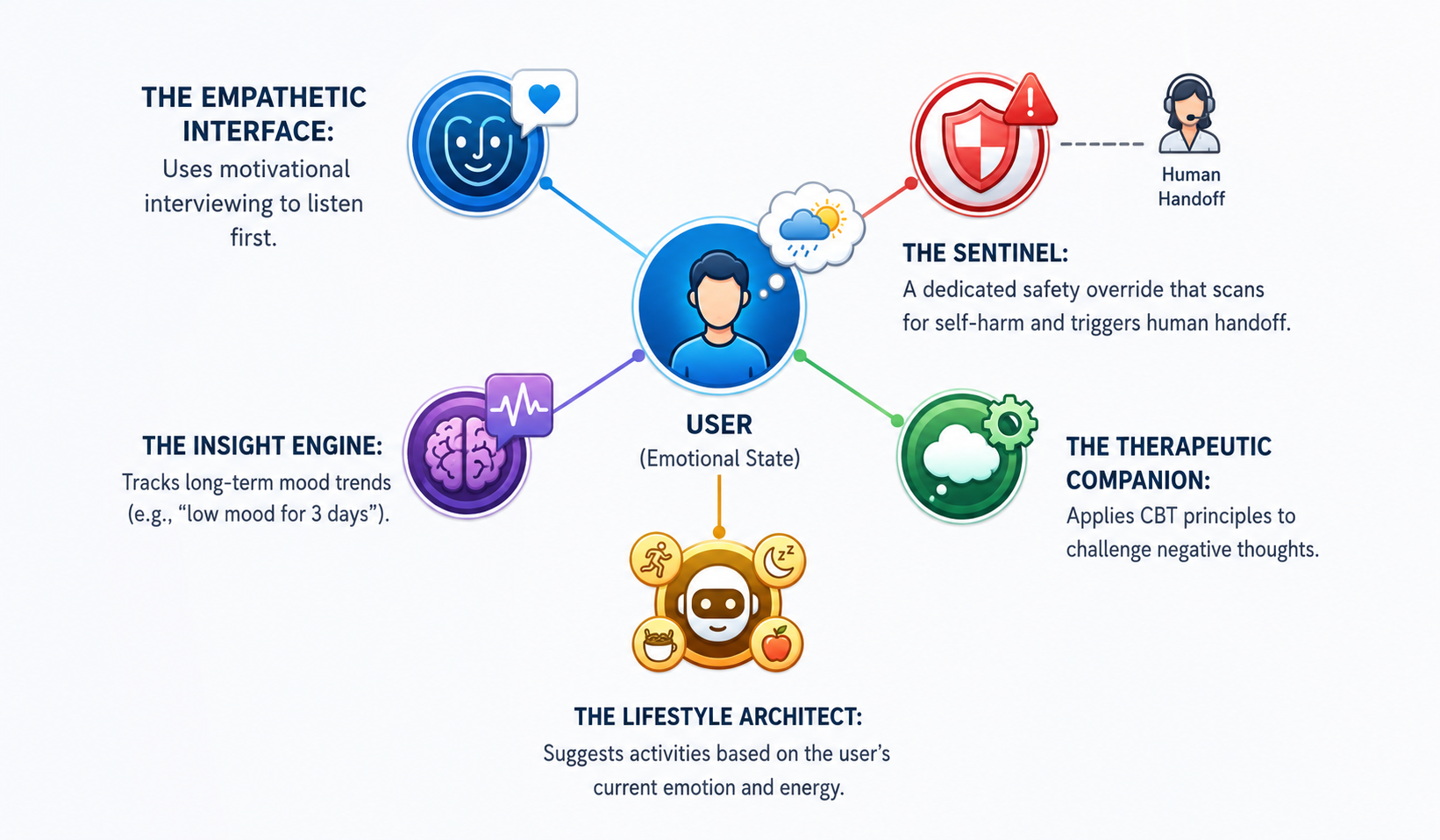
The architecture includes:
- Empathetic Conversation Agent for emotionally aware interactions
- Mood Insight Engine for emotional trend analysis
- Safety Monitoring Agent for crisis detection
- CBT-based Support Agent for cognitive behavioral guidance
- Lifestyle Recommendation Agent for adaptive wellness suggestions
The platform maintains contextual memory using session-aware emotional state management, allowing the AI to remember previous conversations, emotional patterns, coping strategies, and user preferences.
A safety-first orchestration layer continuously evaluates user conversations for high-risk emotional signals and activates escalation workflows when necessary.
The system further integrates Retrieval-Augmented Generation (RAG), emotional context tracking, behavioral analysis, observability pipelines, and scalable asynchronous processing to ensure production-grade reliability and personalization.
Architecture
- User Interaction Layer: Handles user conversations and engagement.
- Empathetic Interface Layer: Provides empathetic emotional support.
- Emotion Detection Layer: Detects emotions, stress, and sentiment.
- Insight Engine Layer: Tracks mood trends and emotional patterns.
- Safety Monitoring Layer: Detects crisis and self-harm risks.
- CBT Support Layer: Provides CBT-based emotional guidance.
- Lifestyle Recommendation Layer: Suggests wellness activities and coping actions.
- Session Memory Layer: Maintains conversation and emotional history.
- RAG Knowledge Layer: Retrieves mental wellness information and resources.
- AI Orchestration Layer: Manages agent workflows and response generation.
- Observability Layer: Monitors safety, performance, and system health.
Impact of the Solution
The implemented emotional resilience platform significantly improved personalized emotional support quality and conversational safety.
- Enabled emotionally intelligent AI conversations with contextual memory and personalized support.
- Improved user engagement by maintaining long-term emotional continuity across sessions.
- Enhanced safety through proactive crisis detection and risk-aware conversational workflows.
- Delivered adaptive emotional wellness recommendations based on user mood and behavioral context.
- Reduced response genericness by leveraging emotional trend analysis and contextual AI orchestration.
- Improved emotional support quality using CBT-inspired conversational guidance mechanisms.
- Enabled scalable and secure AI-powered emotional wellness support available 24/7.
- Enhanced observability through emotional risk monitoring, safety analytics, and conversational quality tracking.
- Supported scalable deployment using asynchronous AI orchestration and modular multi-agent architecture.
Technologies Used
- Workflow Orchestration Systems
- Large Language Models (LLMs)
- Multi-Agent AI Architecture
- Sentiment & Emotion Analysis
- Cognitive Behavioral Therapy (CBT)
- Retrieval-Augmented Generation (RAG)
- Session Memory Management
- Vector Database (pgvector)
- FastAPI / Python Backend
- PostgreSQL
- Redis
- Observability & Monitoring Systems